What Bayonet Training Taught Me About Leadership, Business, and Modern Complexity
Most people think bayonet training was about teaching soldiers how to fight with a rifle and blade. It wasn’t. It was about teaching commitment, decisiveness, aggression under pressure, and the ability to move forward when hesitation feels safer. Years later, I realized those same lessons apply directly to leadership, technology transformation, and navigating complex business environments. In a world obsessed with endless analysis, consensus, and risk avoidance, the organizations that succeed are often the ones willing to act decisively amid uncertainty. The battlefield may have changed, but human nature hasn’t — which is exactly why even modern Ranger assessments still emphasize close-combat mindset and controlled aggression as indicators of leadership potential.
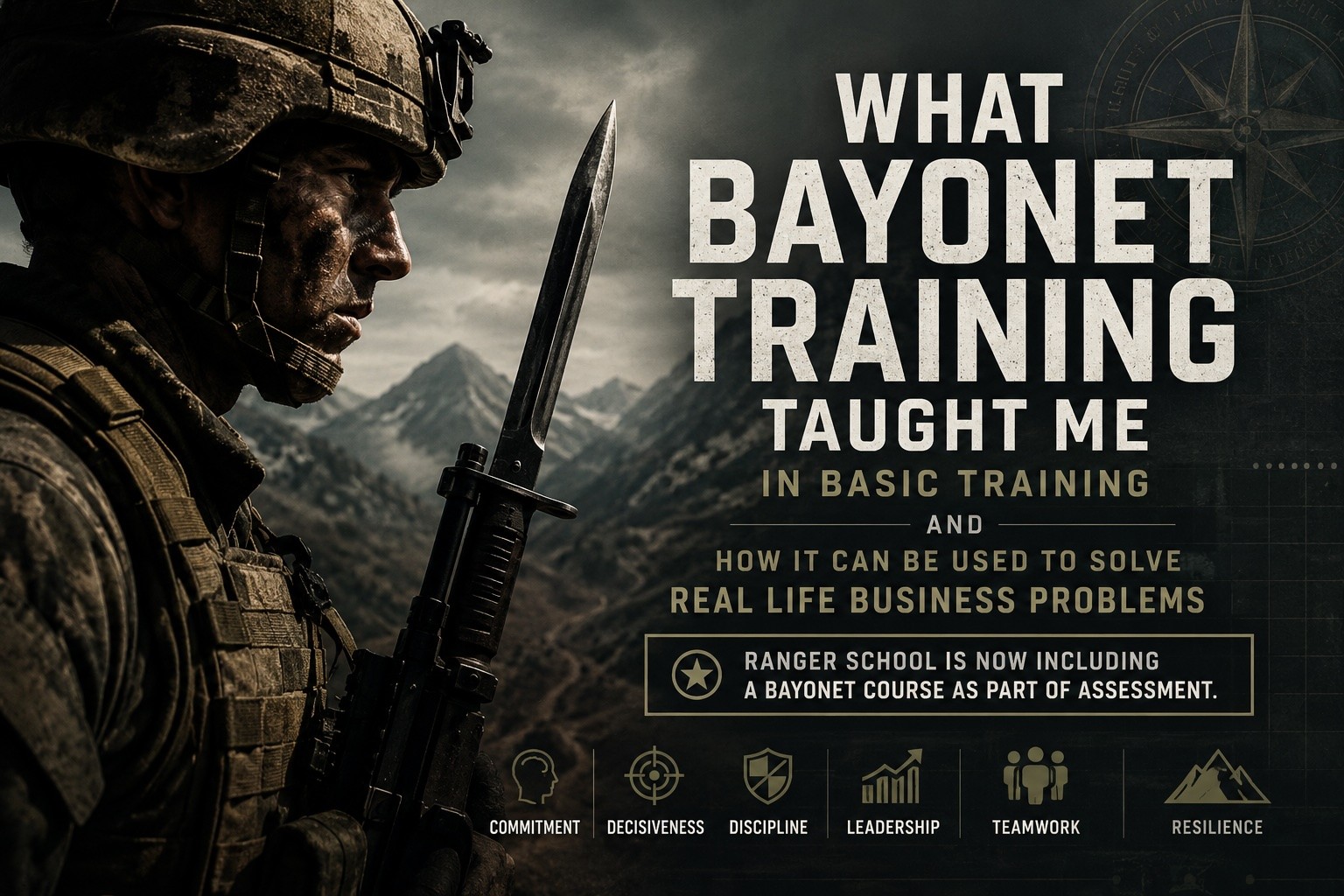
When most people hear the term bayonet training, they picture something outdated — a relic from another era of warfare. They imagine brute force, screaming drill sergeants, and a skillset that has little relevance in a world dominated by drones, cyber warfare, AI, and precision systems.
That interpretation misses the point entirely.
The bayonet was never just about the weapon.
It was about mindset.
During Army basic training, bayonet drills were designed to teach something far more important than hand-to-hand combat. The Army was teaching young soldiers how to move forward aggressively under stress, commit fully to action, maintain discipline amid chaos, and overcome hesitation when the environment became uncertain or violent.
In other words:
The exact same things required to lead organizations through modern business complexity.
Ironically, even as warfare evolves technologically, the Army appears to recognize this principle is still relevant. The U.S. Army recently reintroduced bayonet-style combat assessment components into Ranger training evaluations — not because modern Rangers expect to fight mass bayonet battles, but because close combat assessment reveals something important about a person's aggression, resilience, commitment, and ability to function under pressure.
That lesson matters far beyond the military.
The Real Lesson Was Never the Bayonet
The most important thing I remember from bayonet training wasn't technique.
It was commitment.
Half-speed didn't work.
Hesitation didn't work.
Indecision got exposed instantly.
The drills forced you to move through resistance aggressively and decisively. Once you committed, you had to continue driving forward. You learned quickly that uncertainty was often more dangerous than making the wrong move decisively.
Business leaders experience this constantly.
Companies stall not because leaders lack intelligence, but because organizations become trapped in endless cycles of analysis, consensus seeking, political positioning, and fear of imperfect execution.
The result?
Momentum dies.
Competitors move faster.
Teams lose confidence.
Execution collapses under the weight of hesitation.
One of the most dangerous phrases inside organizations is:
"Let's wait until we have perfect information."
You almost never will.
Violence of Action — Without the Violence
One concept repeatedly emphasized in military training is violence of action.
People misunderstand that phrase. It does not mean recklessness or emotional behavior.
It means focused intensity.
Decisive execution.
Total commitment once action becomes necessary.
In business, the best leaders I’ve worked with operated this way during crises:
ERP failures
Cybersecurity incidents
Supply chain collapses
Revenue instability
Organizational dysfunction
Major technology transformations
The successful organizations were rarely the calmest organizations initially.
They were the organizations that aligned quickly, made decisions quickly, communicated clearly, and moved aggressively toward stabilization.
Meanwhile, failing organizations often became passive.
Everyone waited.
Nobody wanted ownership.
Politics replaced execution.
Meetings multiplied while progress slowed.
Bayonet training taught a simple principle:
Forward pressure matters.
Most Modern Problems Are Psychological, Not Technical
This becomes especially true in technology leadership.
Most enterprise problems are not caused by a lack of technical capability.
The tools already exist.
The platforms already exist.
The data already exists.
The real barriers are usually:
fear of change
organizational inertia
weak accountability
leadership hesitation
unclear priorities
fragmented communication
cultural resistance
In the military, hesitation under pressure creates vulnerability.
In business, hesitation creates organizational drift.
And drift is dangerous because it often feels safe while the company quietly loses ground.
Controlled Aggression Matters
One thing the military does exceptionally well is separating aggression from emotion.
Good soldiers are not uncontrolled.
Good leaders are not uncontrolled either.
The best leaders I’ve seen maintain calm externally while driving extremely hard internally.
That combination matters.
Because modern organizations are incredibly complex systems:
cloud infrastructure
AI adoption
cybersecurity threats
global logistics
investor expectations
operational scaling
digital transformation
workforce fragmentation
Leaders cannot afford emotional volatility.
But they also cannot afford passivity.
The balance is controlled aggression:
decisive without panic
assertive without ego
urgent without chaos
disciplined without paralysis
That mindset becomes a competitive advantage.
Ranger School and Why This Still Matters
Some people are surprised to hear that Ranger assessment standards continue evolving to evaluate close combat aggression and resilience traits.
But it makes perfect sense.
Elite organizations — military or corporate — are ultimately evaluating the same underlying qualities:
composure under stress
adaptability
resilience
aggression when necessary
team leadership
endurance
mental toughness
commitment to action
Technology changes.
Human nature does not.
The battlefield evolves.
Business evolves.
But pressure still reveals character.
Business Complexity Rewards Decisiveness
One lesson I carried from military training into executive leadership is this:
Complexity punishes hesitation.
This does not mean leaders should become reckless.
It means leaders must learn how to:
absorb incomplete information
make decisions under ambiguity
adjust quickly when conditions change
maintain momentum during uncertainty
communicate confidence during instability
The organizations that survive disruption are usually not the organizations with perfect plans.
They are the organizations capable of adapting aggressively and coherently while everyone else freezes.
Final Thoughts
Most people think bayonet training was about fighting.
It wasn’t.
It was about learning how to move through resistance decisively when fear, uncertainty, exhaustion, and chaos were present simultaneously.
That lesson becomes incredibly relevant in modern business.
Because today’s leaders are constantly navigating uncertainty:
AI disruption
economic instability
cyber threats
organizational fatigue
political fragmentation
rapidly changing markets
Under those conditions, hesitation becomes contagious.
So does confidence.
And often, leadership comes down to one deceptively simple question:
When the organization encounters resistance, do you freeze — or drive forward?
That was the real lesson behind the bayonet all along.